
Delaware’s Forgotten World War II Hero: Wilmer Earl Gallaher at Midway – Part VII – Legacy
VII. Legacy
A. The Battle
There is no question that the Battle of Midway is remembered by history as the turning point of the Pacific war. Prior to it, the Japanese had appeared unstoppable. After, Japan’s ability for large-scale offensive operations was crippled. It did not have the capacity to replace either the aircraft carriers or the highly-trained pilots.
This dramatic change in fortune was due to a combination of things. A full analysis and literature survey are beyond the scope of this report. Yet, it is illustrative to summarize the thoughts of “Dusty” Kleiss, a key VS-6 participant in the battle and friend of Gallaher. He believed that credit should go to the skill and training of the pilots, the martyrdom of the torpedo bomber squadrons flying on a “suicide mission”, and the quality of the SBD-3 dive bomber.36
He also believed that the admirals get too much credit. However, without the American code breaking skill, the confidence Admiral Nimitz had in the subsequent intelligence, and the risk Nimitz took in placing ALL the Pacific carriers near Midway, the pilots would not have been in position to do their work.
Finally, Kleiss discounted the “luck theory” of the timing that he said cheapens what the aviators accomplished. Clearly, the outcome would have been different if the dive bombers had come at a different time from when the Japanese planes were rearming and refueling on deck and the torpedo planes had brought the Japanese combat air patrol down to low altitudes. Yet, there is an old saying that “serendipity rewards the prepared mind”. Perhaps this saying can reconcile the two views because the American dive bomber pilots were sufficiently trained and prepared to take advantage of the opportunity.
And yes, the battle pivoted on the events over a very short time window. Mitsuo Fuchida, Japanese pilot on board Akagi during the battle and leader of the first wave at Pearl Harbor is quoted by Simms and McGregor as saying:
“Five minutes! Who would have dreamed that the tide of battle would shift completely in that brief interval of time?”37
B. Wilmer Earl Gallaher
How does history remember Wilmer Earl Gallaher? Despite his prominent role in the battle, and the effusive praise of him by “Dusty” Kleiss, he is largely forgotten by all but World War II buffs and historians. When Gallaher passed away in 1983, Bill Frank of the Wilmington News Journal wrote a piece entitled “Once again Delaware has forgotten one of Its outstanding heroes”. This article is given in its entirety in Appendix A. Frank pointed out that Gallaher’s obituary in his hometown newspaper was only 4 paragraphs long. It trivialized his actions as:
“During World War II, he served at Pearl Harbor and Midway, and in several other battles. He had worked most recently as an instructor for Northwestern High School’s Junior Naval ROTC program.”38
How demeaning!
Gallaher never wrote a book like Kleiss did towards the end of his life, so unfortunately, the subsequent 42 years have not changed this situation. Gallaher doesn’t even have a Wikipedia page!
Another Delaware World War II hero, George S. Welch, had an elementary school named for him at the Dover Air Force Base. Welch was one of the few American pilots to fly at Pearl Harbor and shoot down Japanese planes.39 Ironically, there actually is a Gallaher Elementary School in Newark, Delaware. However, it is named for someone else, Robert S. Gallaher, former president of the Newark School Board.40
The one place Gallaher is publicly feted is at the National Museum of the Pacific War, Fredericksburg, Texas41. A display there includes items he wore during the battle (Figure 10).
Perhaps this report will jumpstart efforts to get proper recognition for one of Delaware’s greatest modern heroes. Both the 85th anniversary of Midway and the 120th anniversary of his birth are in 2027. With the last of the “Greatest Generation” passing away, it is finally time for him to get his long overdue recognition.
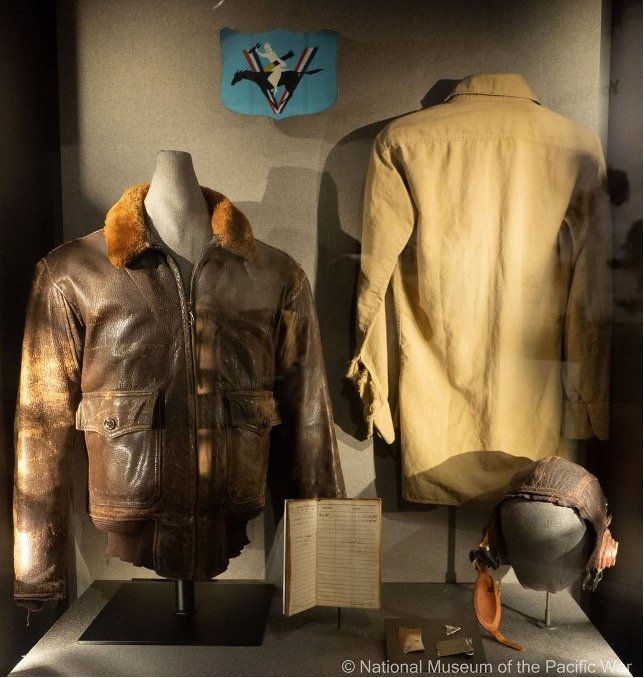
Figure 10: Gallaher’s Midway Flight Jacket, Shirt, Helmut, and Logbook on display the National Museum of the Pacific War, Fredericksburg, Texas41
© 2026 Mark Weinberg. Published by the Delaware Genealogical Society.
Updated 9 April 2026