
Delaware’s Forgotten World War II Hero: Wilmer Earl Gallaher at Midway – Part V – The Battle of Midway: Gallaher’s Critical Role in the Carrier Strikes
V. The Battle of Midway: Gallaher’s Critical Role in the Carrier Strikes
The Morning Attack
On 28 May 1942, Task Force 16 with Enterprise and Hornet left Pearl Harbor. Though Admiral Halsey was no longer in charge of the operation due to a severe case of dermatitis, Kleiss said that:
“Gallaher knew a little more about the upcoming operation than most pilots on Enterprise. Years earlier, he had dated Halsey’s daughter, Margaret.”19
Based on the broken code and subsequent intelligence, American reconnaissance planes began searching the expected area on 4 June 1942. As both predicted and hoped for, the Japanese fleet was spotted. Gallaher and his fellow pilots were ready to be launched. He felt:
“the feeling of anticipation, more than any kind of fear or anything like that, the anticipation of the fact that we were really gonna have the chance, this was my feeling and I know the feeling of many of the pilots, of paying them back for Pearl Harbor.”10
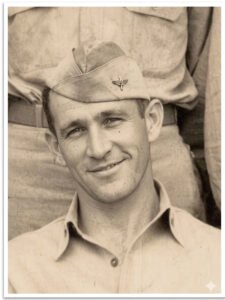
Figure 5: Gallaher at Midway20
In the meantime, Admiral Nagumo, commander of the Japanese fleet, launched his strike on Midway Island. The attack did considerable damage, but did not put its airfield out-of-commission and end the threat of land-based planes. Thus, a second strike was needed and the planes that had been armed with torpedoes to attack any American ships had to be rearmed with bombs. This was a non-trivial operation that took considerable time. It is important to note that Nagumo’s understanding of the tactical situation was significantly clouded by a series of uncoordinated American attacks from Midway and incomplete reports from his own reconnaissance aircraft. When the American ships were finally spotted, Nagumo’s planes had to be rearmed with torpedoes because of the bigger carrier-based threat. His planes from the Midway attack also needed to land. This took more time.
Then, the first of the carrier-based American planes arrived: Torpedo Squadron 8 (VT-8) from Hornet commanded by LTCR John Waldron. It was a suicide run: flying slowly and steadily, at low altitude, with no fighter escort, and with torpedoes that tended to not work. No damage was done. All fifteen planes were shot down and only one pilot survived, ENS. George Gay. He was famously able to stay afloat to observe the rest of the American attack and be rescued. Torpedo Squadron 6 (VT-8) from Enterprise was next to sacrifice themselves. Nine of fourteen planes were shot done.
What the heroism of the torpedo squadrons did accomplish was to bring the Japanese fighters to low altitudes and open the skies to the dive bombers that were on the way.
However, the Japanese fleet was not in the position the dive bombers expected. When LTCR Wade McClusky, Enterprise’s air group commander, could not find them, and with his air group’s fuel running low, he began a search and soon spotted a Japanese destroyer steaming fast. Assuming that she must be following the main fleet, McClusky ordered a change in course to follow. This led him directly to the enemy carriers and the attack.
McClusky’s bomb missed, but Gallaher had what he called “the perfect dive” and squarely hit the Kaga. Then Gallaher:
“couldn’t resist the temptation” and did what he had warned his men not to do: “kind of stand your plane on its tail and watch the bomb hit.” His radioman said, “god damn, that was a beaut captain.”10
“For Gallaher, this was a particularly poignant moment. It was revenge for his fellow Scouting Six pilot Johnny Vogt, who had been shot down over Pearl Harbor. It was revenge for the destruction wrought on the battleship USS Arizona that day, the aftermath of which Gallaher had witnessed and would never forget. ‘Arizona’, he said to himself as his bomb struck home, ‘I remember you.’”21
Other bombs landed on Kaga, including one by Kleiss. Figure 6 shows a painting of the attack.
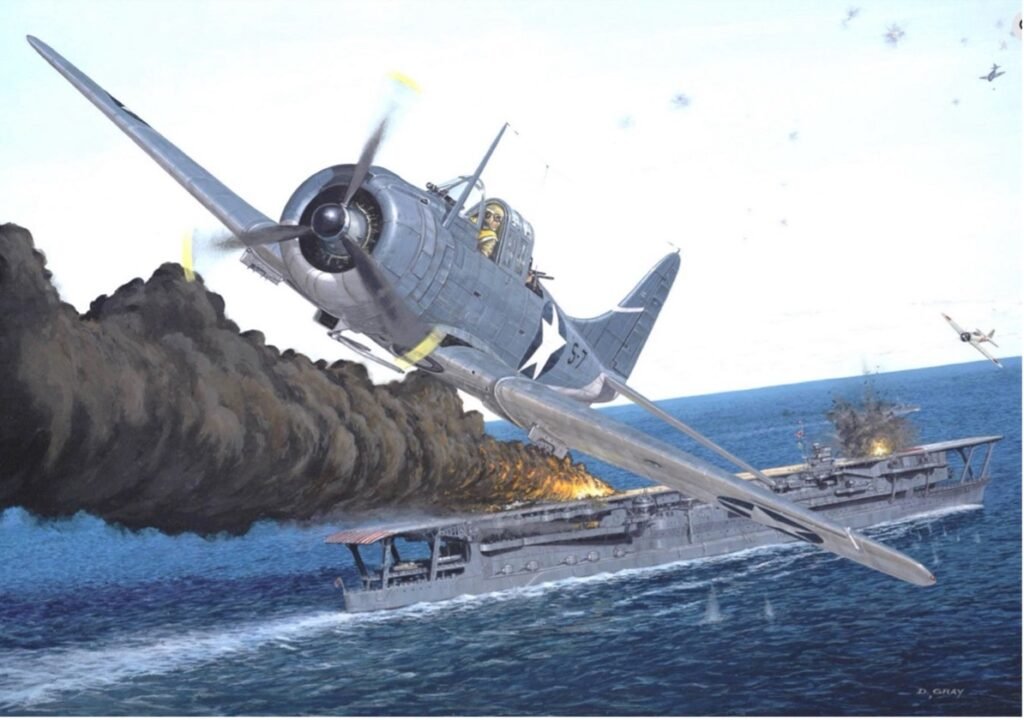
Figure 6: Aviation artist David Gray’s depiction of LT. Dusty Kleiss’s diving attack on Kaga, LT Earl Gallaher scored the first hit. (The flaming wreckage near the stern represents his bomb strike.) Dusty scored the second hit. (His bombs–one 500-pounder and two 100-pound incendiaries–are going off near the bow the carrier.) LT Clarence Dickinson scored the third hit (also amidships, possibly near the bridge), and ENS George Goldsmith scored the last hit, striking Kaga with a 1,000-pound bomb.22
Three VB-6 dive bombers from Enterprise under the command of LCDR Richard (Dick) Best soon hit Akagi, Nagumo’s flagship. Other dive bomber squadrons from Yorktown (VB-3), commanded by LCDR Max Leslie, hit Soryu.
In a few minutes, three of the four Japanese carriers were aflame and on their way to the ocean floor. Kleiss said, “Three frontline Japanese aircraft carriers were huge bonfires, flaming like Kansas straw stacks.”23 The bombing accuracy was impressive: “Twenty-seven pilots attacked Kaga and four scored hits. Three attacked Akagi and one scored a hit. Nine attacked Soryu with three scoring hits.”24
The long search and battle had used a lot of fuel. Several of the pilots ran out and had to ditch. Not all were rescued. Of Gallaher’s squadron, eight of fifteen returned, two others ditched and were rescued, and six were unaccounted for (Appendix B).
The Afternoon Attack on the Hiryu
Despite the destruction, there was one Japanese carrier still left, the Hiryu. In fact, Hiryu’s planes successfully bombed Yorktown twice, which eventually was sunk by a Japanese submarine. Scouting planes located Hiryu in the afternoon and the pilots prepared for another strike. Enterprise’s air group commander, McCluskey, had been wounded in the morning operation. Gallaher was the most senior of the remaining pilots and thus, was given command. Kleiss wrote:
“I was overjoyed to hear our superb skipper would be leading us. Gallaher’s leadership shined immediately. He drew up a plan that differed greatly from the morning attack. Instead of wasting time trying to unite the air groups, Gallaher wanted Enterprise to launch its dive bombers and not wait for Hornet’s air group to unite. This way my squadron could conserve its fuel, we could take our time when making our attacks, and we didn’t have to worry about coordinating with other groups.”25
Enterprise deployed twenty-four dive bombers: six from VS-6 (Enterprise), four from VB-6 (Enterprise), and fourteen from VB-3 that had flown off the sinking Yorktown. While the morning mission took three hours to find the Japanese, this one only took ninety minutes. Gallaher went first to bomb, when Hiryu suddenly made a sharp turn. He tried to compensate, but wrenched his back in the process. He missed; others, including Kleiss, did not. Hiryu “looked like a big smoking taco”26 and was doomed.
Gallaher was lucky he was able to land. His back injury initially prevented him from reaching the tailhook lever. Without that activated, nothing would stop the plane from rolling down the deck into the sea. Somehow, he was able to overcome the pain and pull the lever. Gallaher had to be lifted out of the plane and sent to sick bay.
Gallaher’s battle was over, though not for his squadron which continued to fly missions over the next two days. He continued to worry about them:
“At night, when the kids were coming in, I was supposed to be in bed, but I was up on the deck and I squeezed them aboard, every one of them.”10
© 2026 Mark Weinberg. Published by the Delaware Genealogical Society.
Updated 9 April 2026