
Delaware’s Forgotten World War II Hero: Wilmer Earl Gallaher at Midway – Part III – Early War Experiences
III. Early War Experiences
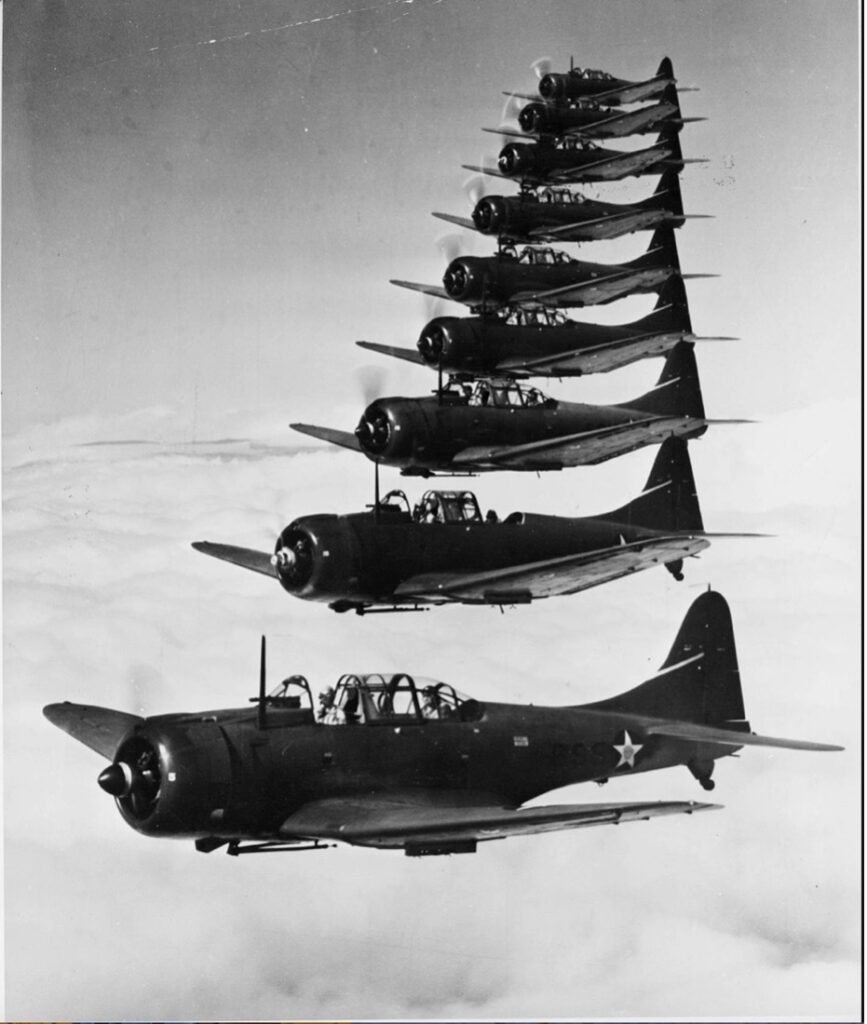
When war broke out, Gallaher was assigned to the USS Enterprise (CV-6) as Executive Officer of Scouting Squadron 6 (VS-6), flying Douglas SBD-3 Dauntless dive bombers. Gallaher was well respected in the unit. “Dusty” Kleiss wrote:
“I liked him instantly. He possessed a friendly demeanor and had excellent skill. Undoubtedly, Gallaher had the best aim of any of the dive bomber pilots in the Navy at the time. He was easily the true genius of our squadron.”6
Gallaher was flying over Hawaii and Pearl Harbor during the Japanese attack on 7 December. He saw the devastation and fought back against the enemy planes.
Enterprise was at sea and was supposed to have been back at Pearl on 6 December. However, it was luckily delayed due to bad weather. The air group of carriers usually returned to land-based airfields when the carriers were in port. Thus, Gallaher was leading a flight when he saw planes flying over Oahu. He first thought they were U.S. Army planes since they would often have mock battles with each other, though it would be unusual for a Sunday morning and without advanced warning. It was then that Japanese Zero fighters began attacking and he saw smoke rising from the harbor. His radioman began to fire at the planes with red balls (“meatballs”) on the side that proved they were Japanese. He radioed “Pearl Harbor is under attack.” He claimed that he didn’t add the rest of the famous message that was rebroadcast to the world: “This is no drill”, but rather “This is no [expletive]”. He landed at a Marine Corps base, Ewa Field, and was told: “get the hell off the ground. Can’t you see what’s going on, the planes are burning all over the field”. He then took off and flew to Ford Island, as he usually did. However, the ground forces started firing at the incoming American planes. A number were unfortunately shot down.10
He saw the wreckage in the harbor and said that he was
“very, very, very upset because the Arizona had been my first ship in the Navy as an ensign, and the Arizona had taken the worst licking. I was very, very upset about that”.10
He and eight others later took off on a bombing run to attack the Japanese ships. However, none were found.10
Enterprise then participated in several hit-and-run raids in early 1942. The first U.S. carrier strike of the war was against Roi and Kwajalein of the Marshall Islands on 1 February 1942. Gallaher successfully hit the stern of a cruiser off Kwajalein.10,11 He became leader of Scouting 6 when LCDR Hopping was shot down.12 Gallaher’s gunner, RM 1/C Thomas Merritt, then shot down the Japanese plane that had shot down Hopping.13 Kleiss said that “…Gallaher was a superb replacement. He led us by example. He demanded perfection and he got it.”12
The next raid on 23 February was on the former U.S. territory Wake Island.
While the results of these raids were minimal, they had a psychological effect on the Japanese, and a positive effect on American morale. Importantly, the pilots gained essential battle experience, but at the expense of a significant loss of pilots. Only eight of the original nineteen pilots who had left San Diego in May 1941 still served by March 1942.14
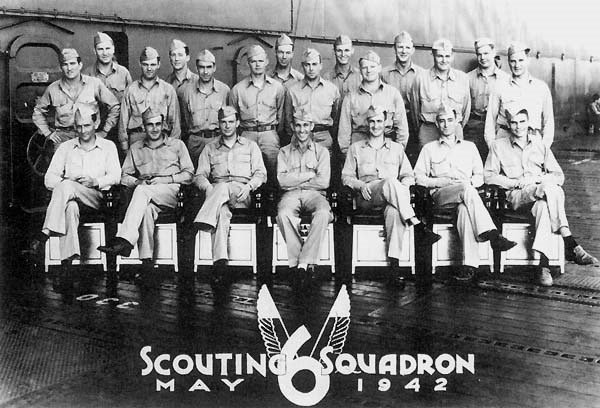
Seated (L-R): Lt (jg) J. Norman West, Lt Frank A. Patriarca, Lt Charles R. Ware, Lt Wilmer E. Gallaher (CO), Lt Clarence E. Dickinson, Jr., Lt (jg) Norman J. “Dusty” Kleiss, ENS John R. McCarthy, AV(N).
Second row (standing) (L-R): ENSs [all A-V(N)] John Q. Roberts, Carl D. Peiffer, James A. Shelton, William R. Pittman, John c. Lough, Vernon L. Micheel, Eldor E. Rodenburg, Thomas F. Durkin, Jr., Richard A. Jaccard, Frank W. O’Flaherty, Clarence E. Vammen, Jr., James C. Dexter, Reid W. Stone, William P. West.
© 2026 Mark Weinberg. Published by the Delaware Genealogical Society.
Updated 9 April 2026